About the Business

Qutahia is a bespoke jeweller in Hull city centre. Visit us at 51 Jameson Street to design your own engagement ring, wedding band, eternity ring or diamond piece. Walk in during opening hours, or book a design consultation so we can sit down with you, talk through your idea and budget, and show you a digital design and a firm price before anything is made. Every piece is made to order in solid, UK-hallmarked 9ct, 14ct or 18ct gold, with natural or lab grown diamonds. Workshop-direct pricing, 3–6 weeks from approval depending on complexity. Not in Hull? We offer video consultations and free insured delivery across the UK.

Business Services
Bespoke Jewellery Making

Bespoke Jewellery Making

Bespoke Jewellery, Made to Your Design

Bespoke jewellery means a piece designed from scratch for one person, rather than chosen off a tray. At Qutahia we commission bespoke jewellery in solid 9ct, 14ct and 18ct gold, working directly from our own workshop with clients across the UK. No showroom of stock, no sales floor, no brand mark-up — your budget goes into the metal, the stones and the hours of work. Meet us in person at 51 Jameson Street, Hull, or by video from anywhere in the UK.

Start your design · commissions from £595

What bespoke jewellery actually means

The word gets used loosely. In the trade it has a fairly precise meaning, and it helps to know where the lines fall before you spend anything.

  • Bespoke — the piece is designed for you from a blank page. Proportions, stone, metal, setting and finish are all decided together. Nothing identical exists.
  • Semi-bespoke — an existing design is adapted: a different stone, a different carat, an engraving. Faster and cheaper, but you are starting from someone else’s drawing.
  • Personalised — a finished piece with your initials, a date or a name added. This is not bespoke, though it is often sold as such.

All three are legitimate. They just cost very different amounts, and it is worth knowing which one you are being quoted for.

How our bespoke jewellery process works

You do not need to know anything about jewellery design to begin. Most people arrive with a photograph, a rough sketch on a phone, or simply a description of someone they love.

  1. Consultation. You tell us the idea, the occasion and the budget. This happens in person at our partner office at 51 Jameson Street, Hull, or by video call or message wherever you are in the UK. There is no charge to talk.
  2. Design and quote. Our jewellers turn the idea into a drawing and an itemised quote: metal weight, stone specification, labour. You see where the money goes before you commit.
  3. Making. Once you approve, the piece enters the workshop schedule. You get progress updates at each stage — wax or model, setting, polishing.
  4. Delivery. The finished piece ships to you insured, with its specification in writing — or you can collect it in person in Hull.

Typical lead time for a bespoke commission is three to six weeks, depending on the complexity of the design and the stone. Rush work is sometimes possible; ask early rather than late.

Who designs and makes your piece

Most people searching for bespoke jewellery designers are really asking two questions at once: who will draw this, and who will actually make it. In a lot of the trade those are different people at different companies, and the gap between them is where commissions go wrong.

A designer produces the drawing. A maker — a bench jeweller — cuts, forms, sets and finishes the metal. Plenty of firms advertising as bespoke jewellery designers do the first part in-house and send the second to a subcontractor they will not name. That is not dishonest in itself, but it means nobody owns the whole outcome, and when something is not right it is slower and harder to fix.

We do both. Our own jewellers design the piece with you and then make it at our benches in the UK and Türkiye. The person who drew your ring is reachable while it is being built, and the workshop that made it is the workshop that stands behind it.

How to judge a bespoke jeweller before you commit

Whoever you use, the same four questions separate a real maker from a middleman:

  • Who physically makes it, and where? A straight answer naming a workshop is a good sign. Vagueness is not.
  • Can I see the itemised quote? Metal weight, stone specification and labour should be separable. If the price arrives as a single number, you cannot tell what you are buying.
  • What happens if it is wrong? Ask specifically who pays to put it right and how long it takes.
  • Can I have the specification in writing? Any maker confident in their work will give you this without hesitation, and it is what lets you verify the finished piece independently.

We answer all four the same way every time, and we actively encourage clients to take the finished piece to any independent jeweller and have it checked.

What bespoke jewellery costs in the UK

This is the question everyone wants answered first and almost no jeweller puts in writing. Here is ours.

Route From What it is
Ready to ship £295 An existing handcrafted piece in solid gold, shipped as-is.
Bespoke commission £595 A one-off piece designed around your brief, from a blank page.
Heirloom commission £1,195 Priority production, a dedicated jeweller, premium stone selection.

Three things move the final number more than anything else: the weight of gold (a heavy signet costs multiples of a fine chain pendant), the centre stone (carat, colour and clarity together, not carat alone), and the complexity of the setting (pavé and hand-engraving are labour, and labour is hours).

What does not need to move the number is overhead. A high-street commission on a comparable specification is commonly quoted at two to four times these figures, and the difference is rent, commission and marketing rather than gold.

Why we don't run a showroom

It is a fair question, and the honest answer is that a showroom is expensive and it is the customer who pays for it. A retail lease, display staff and cabinets full of stock all have to be recovered somewhere, and they are recovered in the price of the ring.

So we don't keep a showroom of finished pieces. Everything is made to order in our ateliers in the UK and Türkiye, with a direct line between you and the people making it. What we do have is a place to meet: our partner office at 51 Jameson Street, Hull, where you can sit down with us, talk through your design, see metal and stone samples, and collect your finished piece. Drop in Monday to Saturday, 9am–5pm, or book ahead so we can give you our full attention. If you are elsewhere in the UK, we do the same consultation by video. Either way you get an itemised quote, and we actively encourage you to take the finished piece to any independent jeweller and have it checked. If it is not exactly as specified, we put it right.

Choosing your metal and stone

Everything we make is solid gold — 9ct, 14ct or 18ct — never plated or filled. The choice is a genuine trade-off rather than a ladder: 9ct is harder and more scratch-resistant and suits daily-wear rings; 18ct is richer in colour and softer, and shows its wear sooner. 14ct sits between the two and is what most of our clients choose for engagement rings.

On diamonds, carat weight is the number people fixate on and it is rarely the one that decides how a stone looks. Cut quality does more work than any other factor — a well-cut smaller stone will out-sparkle a larger dull one every time. The GIA’s explanation of the 4Cs is the clearest neutral summary if you want to understand the grading language before anyone quotes you a price.

Whatever we quote, you get the specification in writing: metal, carat, stone weight and grade. Take it to any independent jeweller and check it. We would rather you did.

What we can make

Most commissions fall into a handful of shapes, and it often helps to look at finished work before describing your own idea:

If your idea is not on that list, it is still worth asking. The unusual commissions are usually the ones worth making.

Frequently asked questions

How much does a bespoke engagement ring cost in the UK?

Our bespoke commissions start at £595 and most engagement-ring projects land between £900 and £2,500 depending on the centre stone. The stone, not the design work, is what moves the total.

How long does bespoke jewellery take?

Three to six weeks from approved design to delivery, depending on the complexity of the piece. Sourcing an unusual stone can add time, so start earlier than feels necessary if there is a date attached.

Can I use my own gold or stones?

Yes. Remodelling inherited jewellery is common, and it can significantly reduce the material cost. We will tell you honestly if a stone is not sound enough to reset.

Can I commission bespoke jewellery without visiting in person?

Yes. Most customers outside Hull do everything remotely: consultation by video call or message, designs as drawings, and the finished piece shipped insured anywhere in the UK. If you are near Hull, you are welcome to meet us at 51 Jameson Street instead.

What is the difference between a bespoke jewellery designer and a maker?

The designer draws the piece; the maker builds it at the bench. Many firms only do one and subcontract the other. We do both in our own workshop, which is why we can answer questions about the build while it is still on the bench.

What if I do not like the finished piece?

You approve the design and the quote before anything is made, which is where most disappointment gets prevented. Every commission also carries a one-year guarantee on our craftsmanship — if something is wrong with the making, we fix it or replace it.

Start your commission

Tell us what you have in mind. A photograph, a sketch, or a sentence is enough to begin, and the first conversation costs nothing.

Start your design →

Business Products

Engagement Rings

Engagement Rings

How much should an engagement ring cost?

There is no correct figure, and the one most people have heard is marketing. The “two or three months' salary” rule was written by an advertising agency in the 1930s to sell more diamonds. It has no basis in tradition and no bearing on whether a ring is good.

What actually determines the number is three things, in this order: the centre stone, whether it is lab grown or natural, and the weight of gold in the setting. Everything else is rounding.

In this collection the range runs from £885 to just over £4,000 for lab grown stones, with natural diamonds reaching considerably higher. Most people land between £1,500 and £3,500 — and at that level the choice is genuinely wide, not a compromise.

The useful question is not how much to spend but where the money goes. A high-street ring at £3,000 carries showroom rent, sales commission and a brand name inside the price. The same specification bought direct from a workshop puts more of that figure into the stone and the metal.

Start with the shape

Shape decides the character of the ring more than any other single choice, and each one has a genuine trade-off:

  • Round brilliant — returns the most light of any cut. The safest choice, and the most expensive per carat because cutting one wastes the most rough.
  • Oval — reads about 10% larger than a round of the same weight and lengthens the finger. Check it for bow tie.
  • Emerald — step cut, so broad flashes rather than sparkle. Demands higher clarity because it hides nothing.
  • Cushion — soft corners, no weak points, the most forgiving shape for daily wear.
  • Marquise — the largest face-up spread of any shape for a given carat. Needs V-prongs to protect the points.
  • Princess — brilliant faceting in a square. Typically 20–30% cheaper than a round of equal quality.

Then choose the setting

The setting decides how the stone sits, how big it reads and how easily it lives alongside a wedding band:

  • Solitaire — one stone, plain band. The least likely design to ever look dated.
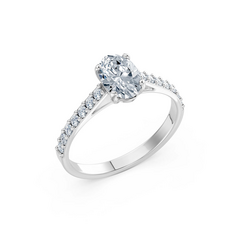
  • Hidden halo — diamonds under the collar, invisible from above. Lifts the stone so a straight wedding band fits underneath.
  • Three stone — past, present and future. Spreads diamond across the finger, so it reads wider than a solitaire of the same centre.
  • Pavé — diamonds along the band. Maximum brilliance, but the band can only be resized slightly, so the size must be right first time.
  • Cluster — several small stones reading as one large one. The most apparent size per pound of any setting.
  • Split shank — the band divides to frame the stone, which makes it look larger without adding a carat.

Lab grown or natural?

A lab grown diamond is a diamond. Same carbon structure, same hardness, same refractive index, same sparkle. A jeweller cannot tell the difference by eye — it takes specialist equipment reading trace growth patterns.

What differs is rarity and price. A lab grown stone costs roughly a third of a mined stone of equal specification, which in practice means a two-carat centre for the budget of a natural three-quarter carat.

The honest case for natural is that it came out of the ground and cannot be made again, and for some people that matters. The honest case for lab grown is that everything you can see is identical and the money buys more of it. Neither is the right answer for everyone; both are real diamonds, and anyone telling you otherwise is selling one of them.

9ct, 14ct or 18ct gold

This is a wear decision, not a quality ladder, and the trade-off runs in both directions.

9ct contains 37.5% gold and more alloy, which makes it harder and more scratch-resistant. It is the most practical choice for a ring worn every day and the most accessible price. 18ct contains 75% gold, giving a deeper, warmer colour and a more substantial feel — but it is softer and shows wear sooner. 14ct sits between the two and is what most of our customers choose for an engagement ring.

Colour is separate from carat. Yellow suits nearly every skin tone and flatters warmer stones; white gives a crisp modern look and makes a colourless diamond look whiter still; rose is softer and increasingly chosen for vintage-styled designs.

Getting the size right

Fingers change size by up to half a size across a day and more across a year. Measure in the afternoon, at normal room temperature, never when cold or straight after exercise. Our British Ring Size Guide covers UK, US and EU sizing with a free printable sizer.

If the ring is a surprise and you are guessing, choose a design that resizes easily — a plain-band solitaire or a three stone. Avoid a full pavé band or a full eternity design, because there is no plain metal to cut and adjust. UK resizing is free with us, but it is far better not to need it.

For more on diamonds, gold and bespoke buying, see our full Guides & Advice hub.

Common questions

What is a realistic budget for an engagement ring in the UK?

Most of our engagement rings sell between £1,500 and £3,500, and the collection starts at £885. Ignore salary-multiple rules; decide what you are comfortable with, then get the best stone and setting for that figure.

Which is the best shape for an engagement ring?

Round brilliant returns the most light and is the safest choice. Oval and marquise give the most visible size for the weight. Emerald is the most timeless. There is no universally best shape — only the one that suits the hand and the person.

How long does an engagement ring take to make?

Ten to fourteen days for anything in this collection. A fully bespoke commission takes four to six weeks depending on the stone — you can start one here.

Can I change the stone, metal or setting on any of these rings?

Yes. Everything is made to order in our own workshop, so shape, carat weight, diamond quality, gold carat and colour are all specifiable on any design here.

Location & Hours

51 Jameson Street

Kingston upon Hull, HU1 3JA
Write a Review