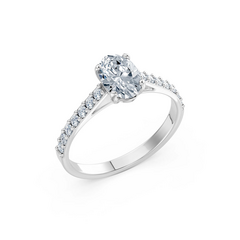
Engagement Rings
How much should an engagement ring cost?
There is no correct figure, and the one most people have heard is marketing. The “two or three months' salary” rule was written by an advertising agency in the 1930s to sell more diamonds. It has no basis in tradition and no bearing on whether a ring is good.
What actually determines the number is three things, in this order: the centre stone, whether it is lab grown or natural, and the weight of gold in the setting. Everything else is rounding.
In this collection the range runs from £885 to just over £4,000 for lab grown stones, with natural diamonds reaching considerably higher. Most people land between £1,500 and £3,500 — and at that level the choice is genuinely wide, not a compromise.
The useful question is not how much to spend but where the money goes. A high-street ring at £3,000 carries showroom rent, sales commission and a brand name inside the price. The same specification bought direct from a workshop puts more of that figure into the stone and the metal.
Start with the shape
Shape decides the character of the ring more than any other single choice, and each one has a genuine trade-off:
- Round brilliant — returns the most light of any cut. The safest choice, and the most expensive per carat because cutting one wastes the most rough.
- Oval — reads about 10% larger than a round of the same weight and lengthens the finger. Check it for bow tie.
- Emerald — step cut, so broad flashes rather than sparkle. Demands higher clarity because it hides nothing.
- Cushion — soft corners, no weak points, the most forgiving shape for daily wear.
- Marquise — the largest face-up spread of any shape for a given carat. Needs V-prongs to protect the points.
- Princess — brilliant faceting in a square. Typically 20–30% cheaper than a round of equal quality.
Then choose the setting
The setting decides how the stone sits, how big it reads and how easily it lives alongside a wedding band:
- Solitaire — one stone, plain band. The least likely design to ever look dated.
- Hidden halo — diamonds under the collar, invisible from above. Lifts the stone so a straight wedding band fits underneath.
- Three stone — past, present and future. Spreads diamond across the finger, so it reads wider than a solitaire of the same centre.
- Pavé — diamonds along the band. Maximum brilliance, but the band can only be resized slightly, so the size must be right first time.
- Cluster — several small stones reading as one large one. The most apparent size per pound of any setting.
- Split shank — the band divides to frame the stone, which makes it look larger without adding a carat.
Lab grown or natural?
A lab grown diamond is a diamond. Same carbon structure, same hardness, same refractive index, same sparkle. A jeweller cannot tell the difference by eye — it takes specialist equipment reading trace growth patterns.
What differs is rarity and price. A lab grown stone costs roughly a third of a mined stone of equal specification, which in practice means a two-carat centre for the budget of a natural three-quarter carat.
The honest case for natural is that it came out of the ground and cannot be made again, and for some people that matters. The honest case for lab grown is that everything you can see is identical and the money buys more of it. Neither is the right answer for everyone; both are real diamonds, and anyone telling you otherwise is selling one of them.
9ct, 14ct or 18ct gold
This is a wear decision, not a quality ladder, and the trade-off runs in both directions.
9ct contains 37.5% gold and more alloy, which makes it harder and more scratch-resistant. It is the most practical choice for a ring worn every day and the most accessible price. 18ct contains 75% gold, giving a deeper, warmer colour and a more substantial feel — but it is softer and shows wear sooner. 14ct sits between the two and is what most of our customers choose for an engagement ring.
Colour is separate from carat. Yellow suits nearly every skin tone and flatters warmer stones; white gives a crisp modern look and makes a colourless diamond look whiter still; rose is softer and increasingly chosen for vintage-styled designs.
Getting the size right
Fingers change size by up to half a size across a day and more across a year. Measure in the afternoon, at normal room temperature, never when cold or straight after exercise. Our British Ring Size Guide covers UK, US and EU sizing with a free printable sizer.
If the ring is a surprise and you are guessing, choose a design that resizes easily — a plain-band solitaire or a three stone. Avoid a full pavé band or a full eternity design, because there is no plain metal to cut and adjust. UK resizing is free with us, but it is far better not to need it.
For more on diamonds, gold and bespoke buying, see our full Guides & Advice hub.
Common questions
What is a realistic budget for an engagement ring in the UK?
Most of our engagement rings sell between £1,500 and £3,500, and the collection starts at £885. Ignore salary-multiple rules; decide what you are comfortable with, then get the best stone and setting for that figure.
Which is the best shape for an engagement ring?
Round brilliant returns the most light and is the safest choice. Oval and marquise give the most visible size for the weight. Emerald is the most timeless. There is no universally best shape — only the one that suits the hand and the person.
How long does an engagement ring take to make?
Ten to fourteen days for anything in this collection. A fully bespoke commission takes four to six weeks depending on the stone — you can start one here.
Can I change the stone, metal or setting on any of these rings?
Yes. Everything is made to order in our own workshop, so shape, carat weight, diamond quality, gold carat and colour are all specifiable on any design here.